How to Write a Verse in a Song: A Practical Guide
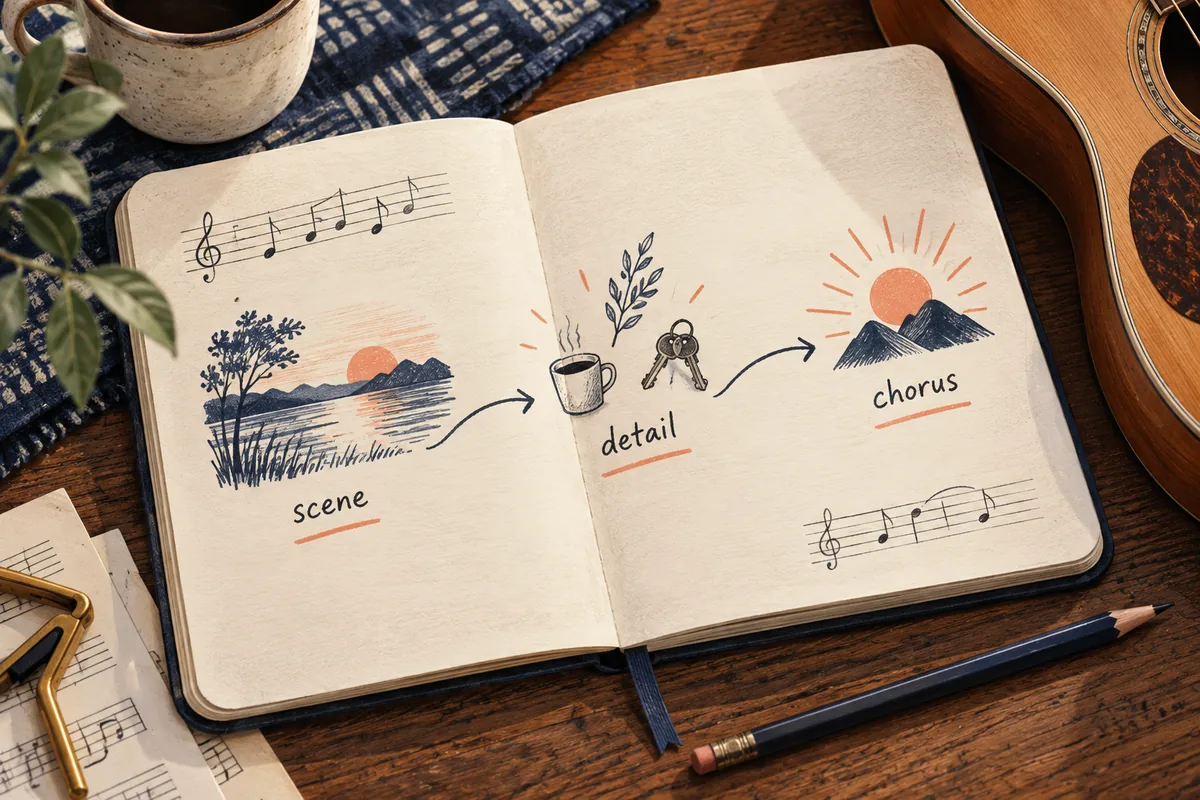
A useful verse gives the listener a scene, a detail, and a reason to need the chorus. Use this process to draft Verse 1, move Verse 2 forward, and revise the lines until they sing naturally.
The short answer: make the chorus feel earned
To learn how to write a verse, decide what the chorus promises, choose one specific moment that prepares it, and write lines that add information instead of repeating the hook. Start with concrete actions and sensory details, then fit the words to a steady rhythm. A first verse sets the scene; a second verse should move time forward, change the point of view, or reveal a consequence. Rhyme and melody help, but clarity and singability decide the line.
- Know the emotional promise or question that the chorus will repeat
- Choose one scene, one point of view, and a small set of concrete details
- Draft meaning before polishing rhyme, syllables, or clever phrasing
- Use eight or sixteen bars as a starting frame, not an unbreakable rule
- Give Verse 2 new information so the repeated chorus changes meaning
1. Understand what a verse must do
When you learn how to write a verse, remember that it is the part of a song that usually changes its lyrics each time it returns. It shows who is present, where the scene happens, what changed, and what the speaker avoids or hopes for. The chorus can state the emotional headline because the verse supplied the evidence.
- Ask what the listener knows after the verse that they did not know before it.
- Keep the verse focused on one moment or one clear change.
- Save the broadest, most repeatable statement for the chorus.
Read what a verse is — for the definition, role, and differences between verse, chorus, bridge, and pre-chorus.
2. Choose the chorus promise and a useful frame
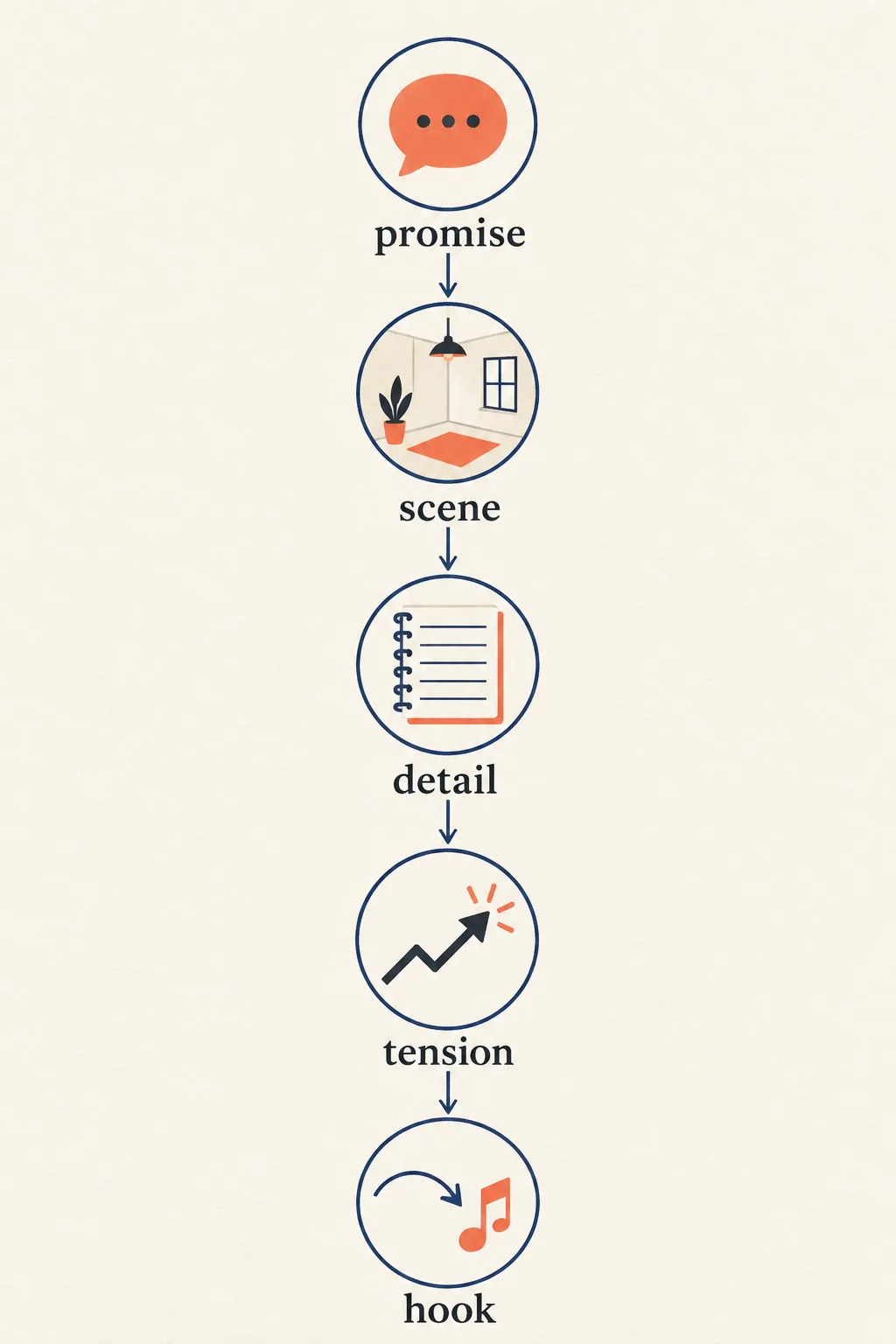
You can begin with a verse, but writing is easier when you know the section it is moving toward. Write the chorus idea in plain language, such as “I keep seeing our old routine in a new city.” Then ask what the listener needs to see before that idea lands.
- Write the chorus promise as one sentence and keep it visible while drafting.
- Choose eight or sixteen bars, then allow a deliberate exception if the melody needs it.
- Decide whether Verse 1 will set a scene, introduce a conflict, or begin in motion.
Shape the chorus promise — before you build the verse that makes the hook feel necessary.
| Choice | Starting point | Why it helps |
|---|---|---|
| Eight bars | Pop, dance, or a quick hook | Reaches the chorus before the scene loses momentum |
| Sixteen bars | Rap, country, rock, or detailed storytelling | Leaves room for a turn, consequence, or extra image |
| Verse 1 | Scene and starting tension | Gives the listener the context for the first chorus |
| Verse 2 | Time shift or changed perspective | Makes the repeated chorus mean something new |
| AABB / ABAB / ABCB | Choose after the idea is clear | Adds sound pattern without forcing the story |
3. Write Verse 1 from concrete details
Start with a camera angle. What would a listener see, hear, touch, or watch if the first line became a short film? List five details from the same place and time: a moving box left open, a train announcement, a cracked phone screen, a second mug, or rain collecting on a window. Choose details that belong together instead of reaching for a new metaphor in every line.
Draft four to eight lines in plain language before you chase perfect rhyme. Let each line perform a small action: place the speaker somewhere, reveal a relationship, introduce a problem, or narrow the question. End the verse on a turn that points to the chorus: an unanswered question, an admission, a decision, or an image that suddenly means more than it did at the start.
- Replace at least one abstract feeling with an object, action, place, or line of dialogue.
- Keep the tense and point of view stable unless a change is intentional.
- Read the last line directly into the chorus and listen for a natural handoff.
4. Write a second verse that moves the story
Verse 2 is where many drafts stall. Do not retell Verse 1 with new rhymes. Move the timeline forward, change the camera angle, show a consequence, or reveal what the speaker understands now. The melody can remain similar so the song feels unified, while the information makes the second chorus land differently.
Place both verses side by side and underline the nouns, verbs, and images. Keep one recurring detail if it acts as a thread, but replace the action around it. If Verse 1 shows the first night in a new apartment, Verse 2 might show the old coffee time a month later. The point is not to make the story complicated; it is to make the repeated hook gain a new shade of meaning.
- Change at least two of time, place, action, consequence, and point of view.
- Let Verse 2 answer or complicate a question raised in Verse 1.
- If the second verse adds no new information, cut it or redesign its job.
5. Shape rhyme, rhythm, and melody after the meaning works
A verse often sits lower and busier than its chorus. Shorter notes and a speech-like rhythm can carry detail, while a narrower melodic range leaves the chorus room to lift. These are tendencies, not rules; choose the contrast that helps listeners follow the story.
- Use rhyme to support the idea, never to decide what the idea must be.
- Record a rough voice memo and listen without looking at the page.
- Leave a little space after an important image so the listener can absorb it.
Explore rhyme options — after you know the line’s meaning, so a rhyme list expands choices instead of replacing the thought.
6. Edit the verse with a three-pass check
Finish a rough draft before polishing isolated words. Then run three passes: replace broad words that weaken the scene, fix stresses that fight the beat, and remove lines that repeat the same job.
- Underline the strongest image in each section and make nearby lines support it.
- Write two alternate versions of the weakest line before choosing one.
- Check that Verse 2 could not be swapped with Verse 1 without changing the story.
Try alternate lyric wording — as a revision prompt, then keep only the changes that preserve your point of view.
Worked example: build two verses around one chorus promise
Imagine a song about missing a friend after moving to another city. Keep the chorus promise simple, then give each verse a different piece of evidence:
- Chorus promise
- Distance changed the routine, but small habits keep the friendship present.
- Verse 1 scene
- On the first night, boxes cover the new apartment and two mugs are unpacked by habit, but only one person is there.
- Verse 1 turn
- The speaker hears the old weekly train and realizes the familiar sound no longer leads to a shared room.
- Verse 2 scene
- A month later, the old coffee time arrives and a voice message appears while the speaker is washing one mug.
- Verse 2 turn
- The message is small, but answering it becomes a deliberate choice instead of an automatic routine.
- Final test
- The chorus should feel more hopeful, more painful, or more specific after Verse 2 than it did after Verse 1.
The verses share one emotional world but do different work. The apartment establishes the absence; the voice message shows what the speaker can choose next. That change is enough to make the repeated hook develop.
Common verse-writing mistakes
Opening with a summary
A broad statement about love, pain, or freedom can sound interchangeable. Start with a moment, object, place, or action that lets the listener enter the story.
Repeating the chorus in disguise
A verse can share the theme without delivering the final conclusion. Save the most repeatable promise for the chorus and build the context around it.
Making Verse 2 a rhyme swap
New end words do not create new information. Add a consequence, time shift, changed location, or different interpretation.
Forcing a perfect rhyme
A natural phrase with a near rhyme is usually stronger than a polished rhyme that changes the speaker’s meaning or voice.
Filling every beat
Space can make an image land. Remove filler words and let a short line, breath, or instrumental gap create contrast.
Frequently asked questions
What is a verse in a song?
A verse is a song section that usually uses changing lyrics to add scenes, details, thoughts, or story information. It gives the song forward motion and helps the repeated chorus feel meaningful. Knowing this role is the first step in learning how to write a verse.
How many bars should a verse have?
Eight or sixteen bars are useful starting points, but genre, tempo, melody, and story decide the final length. Count bars rather than lines and keep only the space needed for the verse’s job.
How do I write a second verse?
Move time forward, change the point of view, show a consequence, or reveal a new interpretation. Keep a recurring image for unity, but do not repeat the first verse with different rhymes.
Does a verse have to rhyme?
No. Rhyme is one way to create cohesion. Rhythm, repeated sounds, internal rhyme, imagery, and a consistent melodic shape can connect a verse without perfect end rhymes.
What is the difference between a verse and a chorus?
The verse usually changes its words to add context or story, while the chorus normally repeats the song’s central emotional idea. The verse makes the chorus matter; the chorus gives listeners the line to remember.
Should I write the verse or chorus first?
Either order works. Starting with a chorus promise gives the verse a destination, while starting with a strong scene can reveal the chorus later. Choose the order that gives you a clear next question to answer.
Further reading
- Splice: What Is a Verse in a Song? — An additional reference for verse roles, common lengths, and songwriting examples.
Turn the idea into a full lyric
Start with one scene, give each verse a different job, and use the tools below to shape a draft in your own voice.