What Is a Rhyme Scheme? Types, Examples, and Songwriting Tips
A rhyme scheme maps which line endings rhyme with one another. Learn how to read the letters, compare common patterns, and use a rhyme scheme without forcing your lyrics.
Quick answer: what is a rhyme scheme?
A rhyme scheme is the pattern formed by the rhyming sounds at the ends of lines. Writers label the first ending A, give the next new sound B, and reuse a letter when a later line rhymes with an earlier one. ABAB means lines 1 and 3 rhyme, while lines 2 and 4 rhyme. The label describes a pattern; it does not decide whether the lyric is good.
- Use letters to mark matching line-ending sounds, not merely matching spellings.
- ABAB alternates two sounds; AABB groups the rhymes in pairs.
- A song can mix end rhyme, near rhyme, slant rhyme, and internal rhyme.
- Choose the pattern that supports the story, rhythm, and voice of the lyric.
1. What a rhyme scheme shows
A rhyme scheme is a shorthand map of recurring sounds across lines. To make one, read or sing the line endings and group the endings that sound alike. The first sound receives A. When a different sound appears, it receives B; a third sound becomes C. The letters describe relationships, so they stay useful even when the actual words change.
In song lyrics, a rhyme scheme is often looser than a classroom poem. A singer may stretch a vowel, use a near rhyme, or place the strongest rhyme inside the line. That is why a written pattern is a starting point for listening, not a replacement for listening.
- Mark the sound you hear at the line ending, not the final letters on the page.
- Treat a near rhyme as a deliberate choice when the sound is close but not identical.
- Listen to the lyric over the beat before deciding that a pattern is broken.
2. How to read A, B, and C labels
Imagine four original lines about leaving a familiar street. If line 1 ends with light, label it A. If line 2 ends with home, label it B. A third line ending with night returns to A, and a fourth ending with roam returns to B. The result is ABAB. The labels do not need to match the vocabulary; they only show which endings share a sound family.
A pattern can contain more than four lines. Continue adding a new letter only when a genuinely new ending sound appears. If the final line does not rhyme with anything else, writers often mark it with a new letter or use X to show that it is intentionally unrhymed.
Try the Lyrics Analyzer — to get an approximate pattern map for your own draft, then confirm the result by speaking or singing the lines.
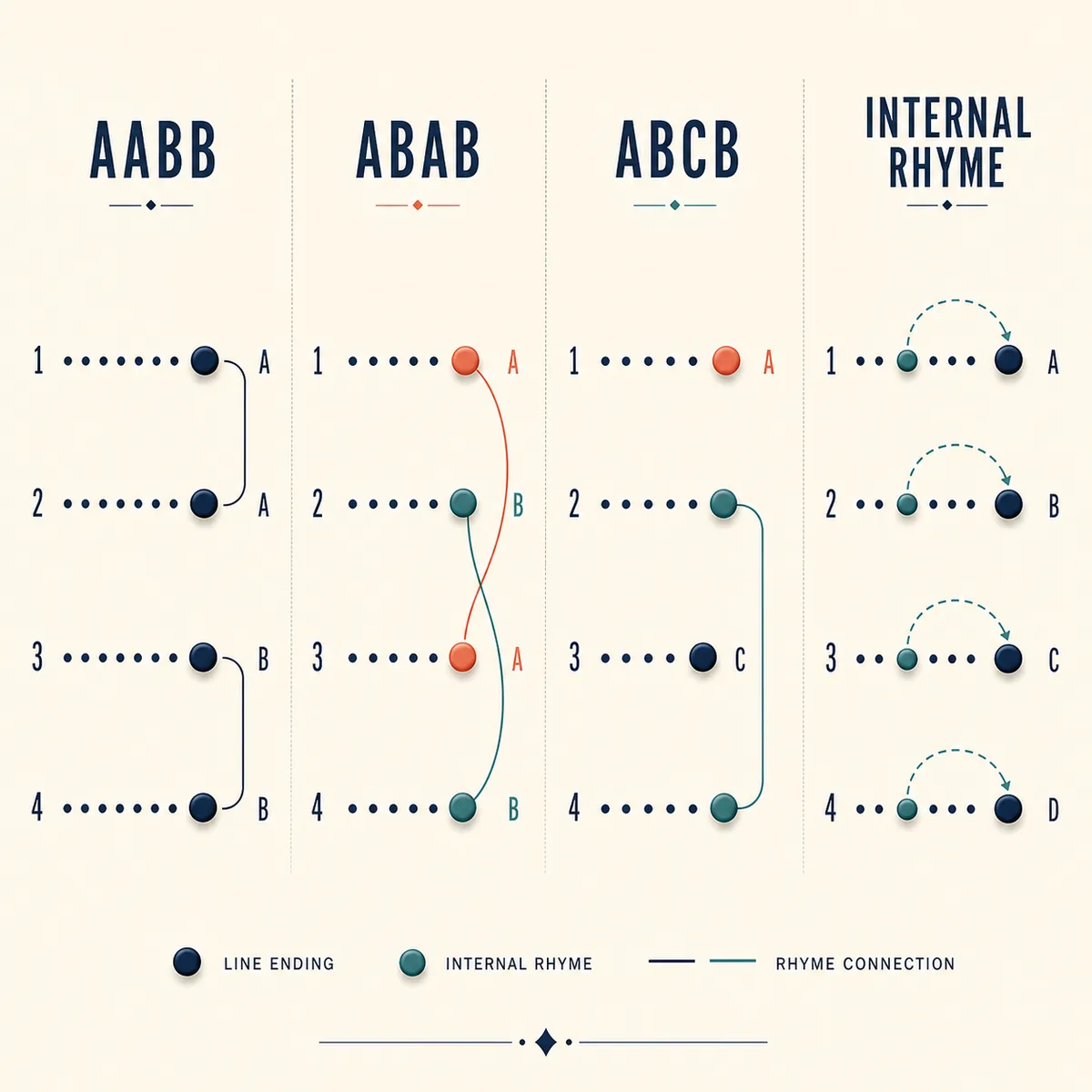
| Pattern | Line relationship | Useful starting point |
|---|---|---|
| AABB | Lines 1–2 rhyme and lines 3–4 rhyme | Clear couplets, simple hooks, short choruses |
| ABAB | Lines 1–3 rhyme and lines 2–4 rhyme | Verses that need movement and balanced return |
| ABCB | Only lines 2–4 share the main end sound | Storytelling with a freer first and third line |
| ABCBX | A later line stays intentionally unrhymed | A final thought that should land outside the pattern |
| Internal rhyme | Matching sounds appear inside one or more lines | Rap cadence, dense verses, and rhythmic momentum |
3. Common rhyme scheme examples
Some patterns appear often because they balance predictability with movement. AABB gives the listener two quick pairs. ABAB spreads the return of each sound across the stanza, which can feel more open or conversational. ABCB keeps the second and fourth lines connected while allowing the first and third lines to move independently.
These patterns are tools rather than rules. A chorus may use a simple AABB pattern for memorability while a verse uses ABAB or ABCB to leave room for story details. Rap and spoken-word lyrics may combine end rhyme with internal connections that are not visible in a four-line label.
- Use AABB when a short section needs a clear, paired landing.
- Use ABAB when you want repetition without making every neighboring line rhyme.
- Use ABCB or an X marker when some lines should stay freer for meaning.
4. Rhyme scheme vs. rhyme type
A rhyme scheme describes where the matching sounds occur. A rhyme type describes how closely the sounds match. Perfect rhyme, near rhyme, slant rhyme, eye rhyme, and internal rhyme are different sound techniques; ABAB and AABB are pattern labels. One ABAB stanza can use perfect rhymes, slant rhymes, or a mixture of both.
This distinction helps when a lyric feels too predictable. You can keep the ABAB structure but replace one perfect rhyme with a near rhyme, move a rhyme inside a line, or let the fourth line remain open. The pattern provides shape while the rhyme type controls texture.
Find rhyming words with the Rhyme Generator — when you need perfect, near, slant, or phrase-level options that still fit the line's meaning.
5. How to identify a rhyme scheme step by step
Start with a short verse or chorus and write each line on its own row. Read the lines aloud at a natural pace. Circle the final stressed sound of line 1 and label it A. Compare line 2 with line 1; give it A if the sound matches, or B if it introduces a new sound. Continue through the section, then read the letter sequence as a pattern.
After the first pass, check pronunciation, stress, and repeated words. A spelling-based match can fail when two words sound different, while a slant rhyme can work even when the spellings do not match. If one line contains an obvious internal rhyme, note it separately instead of forcing it into the end-rhyme sequence.
- Use the sung pronunciation when melody changes the vowel or stress.
- Keep end-rhyme labels separate from internal-rhyme notes.
- Mark an unrhymed line as X when that makes the structure easier to read.
6. How to choose a pattern for song lyrics
Choose a rhyme scheme after you know what the section needs to do. A chorus often benefits from a memorable repeated sound, while a verse may need more freedom for scenes, details, and changing thoughts. A pattern that looks elegant on paper can still sound stiff if it forces an unnatural word or hides the most important image.
Draft the meaning first, then test a small set of endings over the beat. If the rhyme changes the sentence into something you would never say, loosen the pattern or use a near rhyme. For rap, add internal connections and pay attention to cadence; for pop, keep the strongest pattern near the hook without making every line identical.
Read the full song lyric writing guide — for a broader process that connects rhyme, structure, imagery, rhythm, and revision.
Worked example: marking an original ABAB stanza
Here is a short original example about revisiting a childhood street. The words are written only to demonstrate the method, not to imitate a published lyric:
- Line 1 — A
- I trace the old route under borrowed light
- Line 2 — B
- The corner store is quieter at home
- Line 3 — A
- My footsteps learn the shape of night
- Line 4 — B
- I leave before the street can ask me to roam
The first and third endings create the A family, while the second and fourth create the B family. The example is not valuable because ABAB is automatically better; it is useful because the pattern leaves space for the story to move between returns.
Common rhyme scheme mistakes
Choosing the rhyme before the meaning
A perfect rhyme is not worth a vague or unnatural line. Protect the image and the emotional point first, then adjust the pattern.
Treating spelling as sound
Words can look similar and sound different, or look different and rhyme when sung. Always check the spoken or sung ending.
Making every line rhyme
A freer line can create contrast and keep the lyric conversational. Use X or a changing pattern when the section needs breathing room.
Calling every sound match the same
Perfect, near, slant, and internal rhymes create different textures. Name the type separately from the scheme.
FAQ: rhyme schemes in songs
What is a rhyme scheme in simple terms?
It is a letter map of which lyric lines end with matching sounds. AABB means the first two lines rhyme and the next two lines rhyme; ABAB alternates two sound families.
What is the most common rhyme scheme for songs?
There is no single required pattern. AABB and ABAB are common starting points because they are easy to hear, but many songs mix patterns, use near rhymes, or leave some lines unrhymed.
Is ABAB better than AABB?
No. ABAB spreads the rhyme across the section, while AABB creates paired landings. Choose the pattern that supports the melody, story, and amount of repetition you want.
How do I find the rhyme scheme of a song?
Write the lines separately, listen to the final stressed sounds, label the first sound A, and reuse a letter when a later ending matches it. Check the result by singing the lines because pronunciation and melody matter.
Can a rhyme scheme use near rhymes?
Yes. Songwriting often uses near or slant rhymes when an exact rhyme would sound forced. Keep the letter map as a practical description and note the looser sound relationship.
What is the difference between a rhyme scheme and a rhyme pattern?
They usually describe the same overall idea. Rhyme scheme emphasizes the letter notation such as ABAB, while rhyme pattern can also refer more broadly to repeated sounds, internal rhymes, or rhythmic placement.
Further reading
- Berklee: How to Start Writing Lyrics — A songwriting reference for developing lyric ideas, structure, and a workable first draft.
Ready to test your rhyme pattern?
Mark the sounds in a short section, keep the pattern that supports the meaning, and revise any line that feels forced.