What Is a Bridge in a Song? Purpose, Placement, and Examples
A bridge is the contrasting section that gives a song a new angle before it returns to the final chorus. Learn how to hear it, place it, and write one without forcing a key change.

Quick answer: what is a bridge in a song?
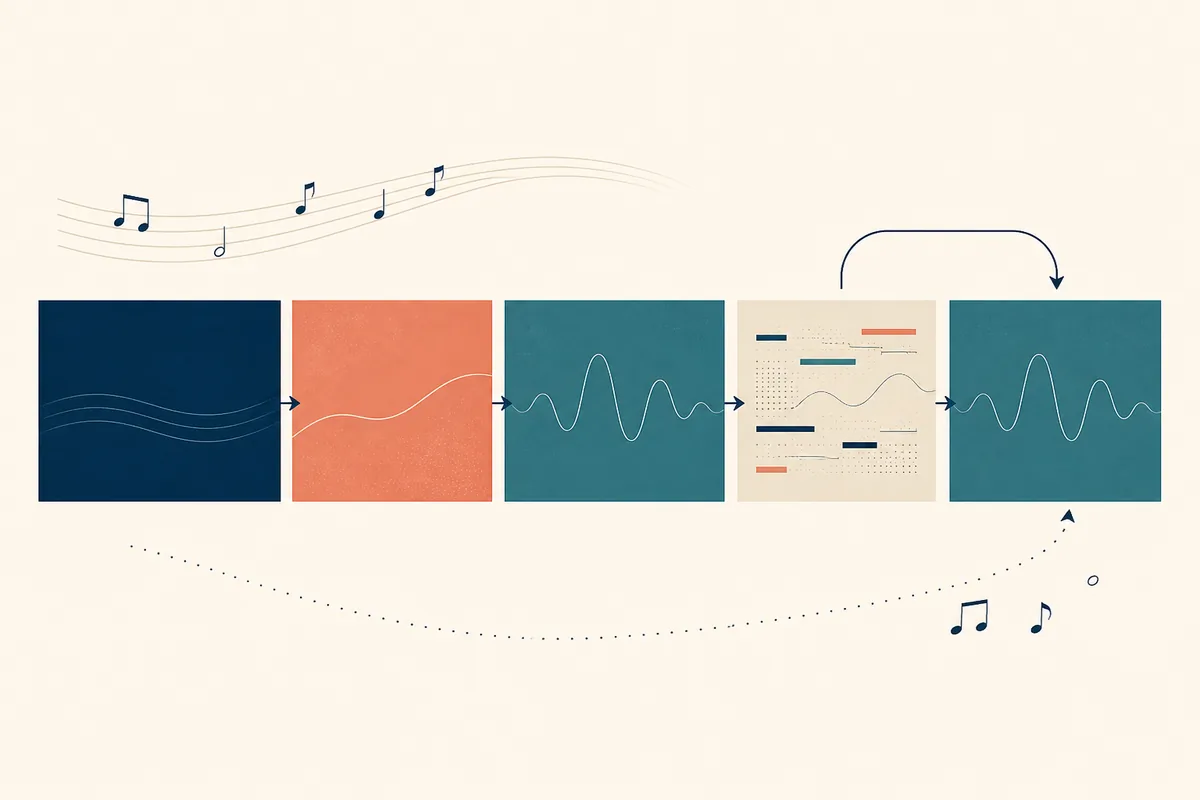
A bridge is a contrasting song section that usually appears after a repeated chorus, often before the final chorus. It can change the melody, chords, rhythm, texture, or lyrical point of view so the next chorus feels refreshed. A bridge is not the same as a pre-chorus: a pre-chorus builds toward the chorus, while a bridge usually creates contrast after the listener already knows the main pattern.
- It gives the song a new musical or lyrical angle.
- It often appears in a Verse–Chorus–Verse–Chorus–Bridge–Chorus shape.
- It can create contrast without changing key or becoming louder.
- It is optional; the song should only use one when the contrast has a job.
1. What a bridge is and where it appears
In songwriting, a bridge is a section that connects one familiar part of a song to another by changing the listener’s perspective. The word does not mean that every bridge must literally connect two different keys or that it must contain a dramatic modulation. Its main job is contrast: after the verse and chorus pattern has become recognizable, the bridge introduces a different shape, thought, or emotional temperature.
The most common placement is after the second chorus and before the final chorus. In a simple V–C–V–C–B–C arrangement, the bridge arrives when the listener understands the central promise and is ready for one more piece of information. Some songs place a bridge earlier, repeat it, or use a short instrumental passage instead. Placement is a tool, not a law.
- Look for a section that appears only once while the chorus repeats.
- Notice whether the lyric changes viewpoint, time, or emotional conclusion.
- Treat the final chorus as the return point the bridge prepares.
2. What a bridge does for the song
A useful bridge solves a repetition problem. The chorus may be memorable, but hearing the same verse-and-chorus loop too many times can flatten the emotional arc. The bridge interrupts that loop with a new contour. It might lower the energy and create intimacy, widen the melody, remove the drums, introduce a new chord color, or state the thought the singer avoided earlier.
Contrast can be lyrical, musical, or both. A bridge in a breakup song might stop describing the other person and admit what the narrator did wrong. A dance track might strip away the kick for a few bars before the final drop. The bridge earns its place when the final chorus means more because something changed before it returned.
- Change one or two strong variables instead of changing everything at once.
- Give the bridge a clear emotional question or discovery.
- Make the return to the chorus feel intentional, not accidental.
Try the Song Structure Generator — to test bridge placement and compare short song layouts before drafting every line.
| Section | Main job | Typical listener question |
|---|---|---|
| Verse | Add scenes, details, or story movement | What is happening? |
| Pre-chorus | Build tension toward the chorus | What is about to arrive? |
| Chorus | Repeat the central emotional promise | What should I remember? |
| Bridge | Create contrast before the return | What has changed or not been said? |
3. Bridge vs. verse, pre-chorus, and chorus
The easiest way to understand a bridge is to compare its job with the jobs of the other major sections. A verse normally adds story details or scenes. A pre-chorus increases momentum and points directly at the chorus. A chorus repeats the central emotional message. A bridge is the deliberate detour: it offers contrast, a new perspective, or a different musical frame before the song returns.
These boundaries are useful, but real songs can blur them. Some bridges sound like a new verse with a different melody. Some choruses change their last lines. Some writers call a middle-eight a bridge, while others use bridge for any one-time section. Focus on the function rather than the label: if the section changes the listener’s frame and creates a satisfying return, it is doing bridge work.
4. How to recognize a bridge by ear
You do not need music theory vocabulary to hear a bridge. Start by mapping the repeated sections: listen for the verse, chorus, second verse, and second chorus. Then ask whether a later section appears only once and feels noticeably different. It may have a new melody, fewer words, a different drum pattern, a changed bass movement, or a vocal line that sits in a new register.
The return is the strongest clue. A bridge often makes the final chorus feel larger, clearer, sadder, or more resolved than the earlier versions. If the one-time section changes the mood but never points back to a familiar destination, it may be an interlude, breakdown, or separate contrasting section instead. The names matter less than the listening function.
- Mark the first moment the main pattern stops repeating.
- Compare the bridge’s lyric perspective with the chorus promise.
- Listen for the musical cue that makes the final chorus feel earned.
5. How to write a bridge that adds contrast
Begin with the sentence the rest of the song has not said yet. If the verses describe events and the chorus states the feeling, the bridge can reveal the decision, doubt, consequence, or new perspective underneath them. Draft the idea in plain language first. A bridge often becomes stronger when it carries one focused thought instead of trying to summarize the whole song.
Next, choose one musical contrast. You could shorten the lines, change the rhythm, hold a longer vowel, move to a different register, reduce the instrumentation, or use a new chord pattern. A key change is allowed, but it is not required. Record a rough version and test the transition into the final chorus. If the chorus sounds exactly the same emotionally, the bridge needs a clearer job; if the return feels forced, the bridge may be too far away from the song’s core.
- Write one bridge sentence before worrying about rhyme.
- Change one musical dimension first: rhythm, register, texture, or harmony.
- End with a line, chord, or breath that makes the final chorus inviting.
Read the beginner lyric-writing guide — for a full process that connects the bridge to the song’s theme, structure, and revision pass.
6. Length, genre choices, and common limits
There is no universal bridge length. Many pop bridges last four or eight bars, but a folk song, rock track, musical-theatre number, or hip-hop arrangement may use a different span. Count the breath, phrasing, and energy rather than copying a number. A short bridge can work if it changes the frame; a long bridge can work if it keeps developing instead of delaying the return.
The same principle applies across genres. A bridge may be an instrumental lift, a rap section, a stripped vocal confession, a new melodic pattern, or a middle-eight with a distinct harmonic color. Do not add a bridge because a template says every song needs one. Add it when repetition has reached a useful turning point and the listener will gain something from the detour.
Worked example: Verse–Chorus–Verse–Chorus–Bridge–Chorus
Imagine a song about leaving a hometown. The verses show train tickets, empty rooms, and the last walk past the river. The chorus repeats the emotional promise: leaving is frightening, but staying would be worse. The bridge should not repeat those images; it should change what the final chorus means.
- Verses
- Show specific memories and the decision building underneath them.
- Chorus
- Repeats the central line about moving forward despite fear.
- Bridge
- Admits that the narrator is not only leaving a place but also forgiving the person they used to be.
- Final chorus
- Returns to the same hook, now carrying the bridge’s new self-understanding.
The bridge does not need a completely unrelated idea. It needs a new angle that changes the pressure around the main hook. When the final chorus returns, the repeated words should feel more specific because the bridge has changed the context.
Common bridge mistakes
Adding a bridge by formula
A bridge is optional. If the song already moves naturally into its final chorus, another section may only slow it down.
Changing every musical element
Contrast is clearer when one or two dimensions change. A total reset can make the bridge sound like a different song.
Repeating the chorus in new words
A bridge needs a new thought, not a paraphrase of the same emotional summary.
Forgetting the return
The bridge should prepare a satisfying destination. Test the final line or chord against the chorus entrance.
FAQ: bridges in songs
What is a bridge in a song?
A bridge is a contrasting section that usually appears after a repeated chorus and before the final chorus. It gives the song a new musical or lyrical perspective, then helps the listener hear the return with fresh meaning.
Where does the bridge usually go?
The most common placement is after the second chorus and before the final chorus, often in a Verse–Chorus–Verse–Chorus–Bridge–Chorus structure. Other placements can work when the song’s emotional movement supports them.
Is a bridge the same as a pre-chorus?
No. A pre-chorus builds tension immediately before the chorus. A bridge usually arrives after the main pattern is established and creates a contrasting detour before the song returns to the chorus or outro.
Do all songs need a bridge?
No. A bridge is optional. Use one when the song benefits from a new perspective, a change in energy, or a clearer path into the final chorus. A strong repeated structure is better than an unnecessary bridge.
How long should a bridge be?
There is no fixed length. Four or eight bars are common in many pop songs, but the right length depends on phrasing, breath, genre, and how much contrast the section needs to create.
Does a bridge have to change key?
No. A key change is one possible form of contrast, but changing rhythm, melody, register, chords, instrumentation, or lyrical viewpoint can be just as effective without leaving the original key.
Further reading
- Berklee Online: Writing Bridges for Your Songs — A songwriting perspective on using a bridge to create contrast and move the song forward.
- Splice: What Is a Bridge in a Song? — A practical explanation of bridge placement, musical contrast, and common song forms.
- BMI: The Bridge and How to Use It — Additional context on the bridge as a distinct songwriting section.
Ready to test a new structure?
Start with a simple outline, then use the bridge only where it gives the song a more meaningful return.