What Is a Verse in a Song? Meaning, Role, and Examples
A verse gives a song its scenes, details, and forward motion. Learn how a verse works, how it differs from the chorus and bridge, and how to draft two verses that make the hook matter.
The short answer: a verse moves the story forward
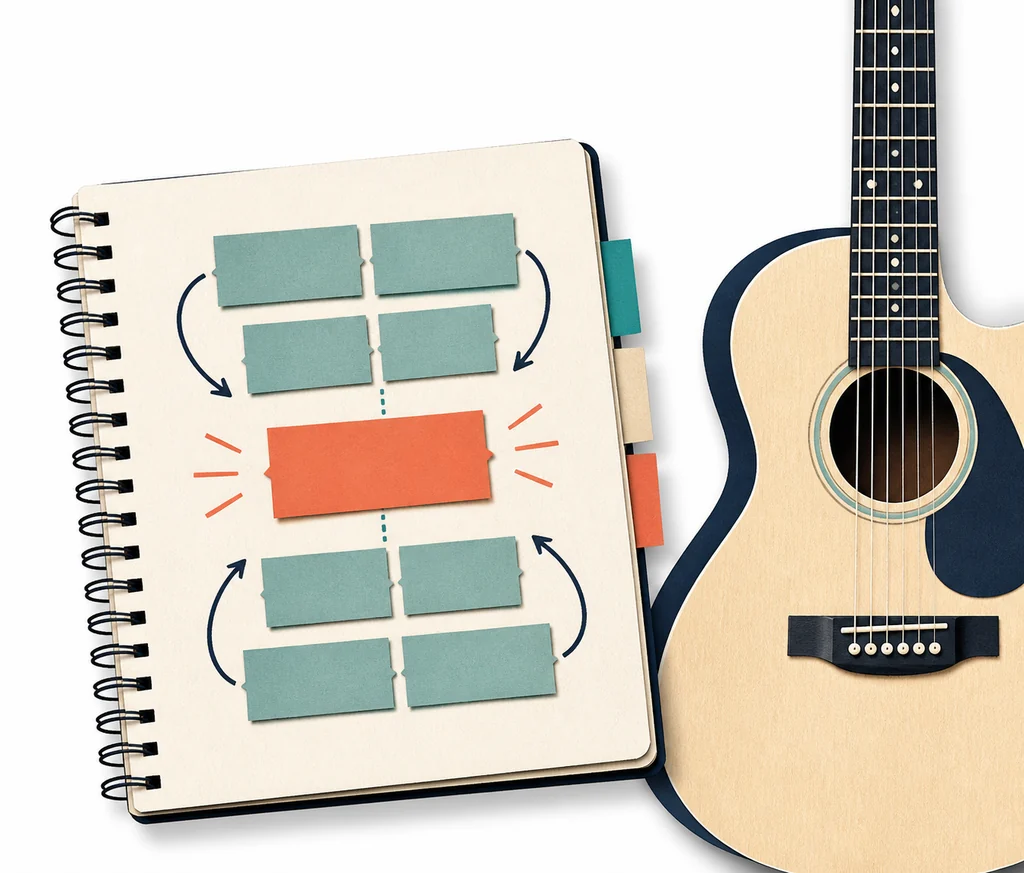
A verse in a song is a section that usually changes its lyrics from one repetition to the next. It introduces scenes, details, thoughts, or consequences so the listener learns something new before the chorus returns. In a simple pop song, Verse 1 may set up the situation and Verse 2 may reveal what changed. The exact melody, rhyme scheme, and length can vary; the important job is to add information without stealing the chorus’s role as the emotional center.
- Use the verse to show what is happening, not only to name a feeling
- Give each verse a clear scene, question, or piece of new information
- Let the chorus repeat the central promise while the verses build its meaning
- Change Verse 2 through a consequence, time shift, detail, or new point of view
- Treat verse length and rhyme as tools that serve the song’s natural phrasing
1. What is a verse in a song?
A verse is the part of a song that usually carries changing lyrics and specific information. It can describe a place, introduce a person, show an action, or reveal a thought that was not available at the start. If the chorus is the sentence listeners remember, the verse is often the path that makes that sentence feel earned.
Verses do not have to follow one universal pattern. A verse may be eight lines or sixteen, rhyme tightly or loosely, and use the same melody each time or develop it. What makes it a verse is its function inside the arrangement: it gives the song forward motion and prepares the listener for the repeated section that follows.
- Ask what the listener knows after the verse that they did not know before it.
- Choose one concrete image instead of stacking several vague emotions.
- Keep the verse connected to the song’s main promise, even when the details change.
2. Verse vs. chorus, pre-chorus, and bridge
The easiest way to identify a verse is to compare its job with the other sections. A chorus normally repeats the song’s central emotional idea. A pre-chorus creates lift or anticipation before that chorus. A bridge introduces contrast, such as a new perspective, melody, harmony, or amount of energy. The verse is the section that usually supplies the changing context around those repeated or contrasting moments.
The borders are not strict. Some songs use a hook inside the verse, skip a pre-chorus, or call a changing section a hook instead of a verse. Labels are useful when they help you plan the listener’s experience, not when they force every song into the same template. The existing Song Structure Guide explains broader patterns; this page focuses on the verse’s storytelling job.
- If the lines repeat almost unchanged, they may be part of the chorus or refrain.
- If a section mainly raises energy into the hook, it may be a pre-chorus.
- If a section changes viewpoint before the final return, it may be a bridge.
Read the Song Structure Guide — for common verse–chorus patterns and a fuller map of every section.
| Section | Main job | Useful question |
|---|---|---|
| Verse | Add scenes, details, or new information | What is happening now? |
| Pre-chorus | Build anticipation or raise energy | Why should the listener lean forward? |
| Chorus | Repeat the emotional center or hook | What should be remembered? |
| Bridge | Create contrast or a new perspective | What has not been said yet? |
| Outro | Close, extend, or echo the song | What should remain afterward? |
3. What does a strong verse do?
A strong verse gives the listener something to picture and a reason to keep listening. Instead of repeating that the speaker feels lonely, it might show an untouched coffee cup, a name still saved in a phone, or the quiet after a familiar train leaves. Details turn an abstract emotion into an experience that can support the chorus.
A verse also creates movement. The movement can be external, such as walking into a new room, or internal, such as admitting why an apology was never sent. By the end of the verse, the chorus should sound more specific than it did on its own. That is why a simple repeated hook can gain new weight after each verse.
- Use a setting, object, action, or line of dialogue as the verse’s anchor.
- Give the last line a turn that points naturally toward the chorus.
- Read the verse aloud and remove lines that explain what the images already show.
4. How to write Verse 1
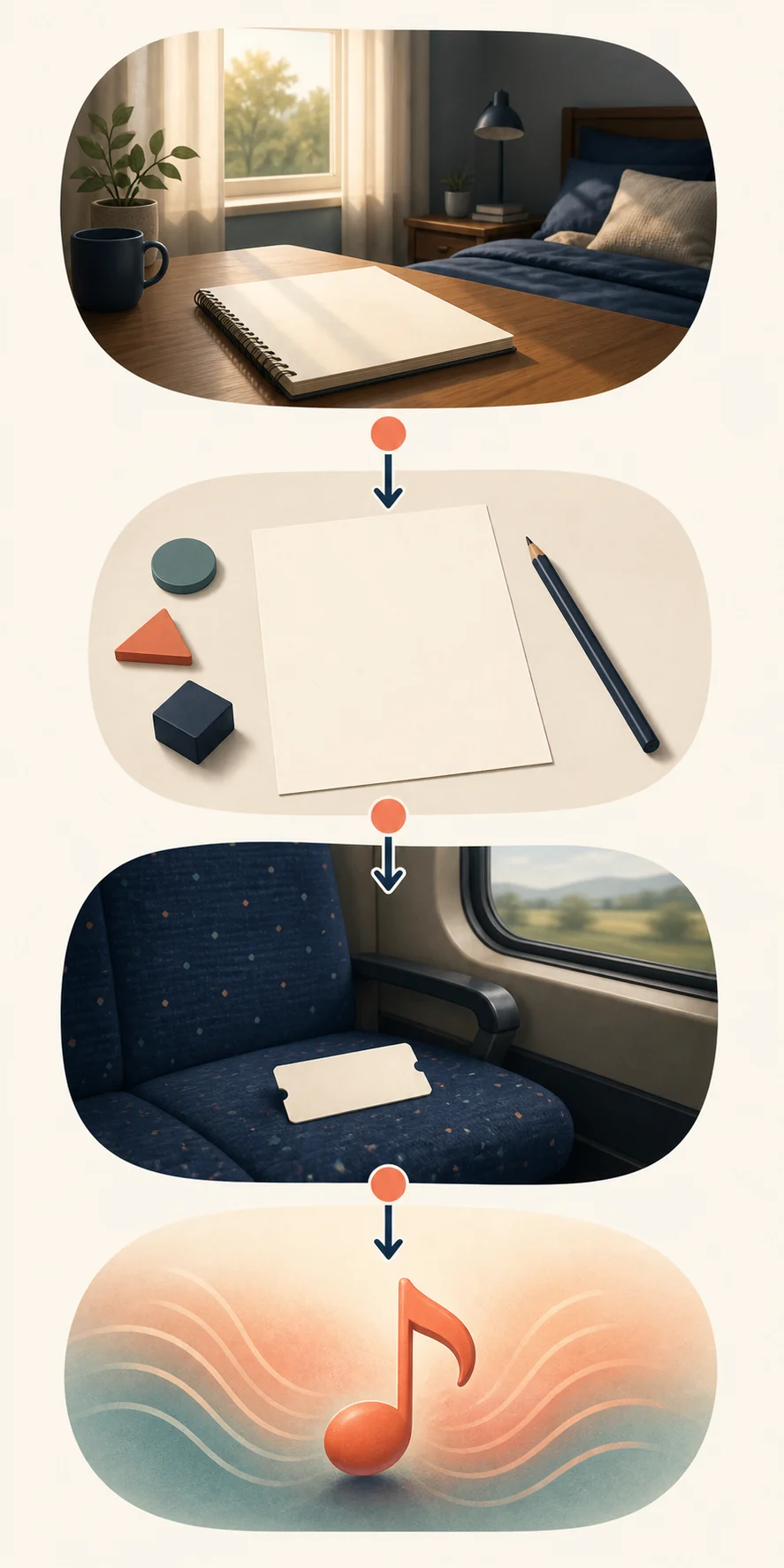
Start Verse 1 at a moment rather than with a summary of the entire song. Choose where the listener is standing, what just happened, or what the speaker is trying not to say. A useful first verse can answer three small questions: What is the scene? What detail makes it personal? What tension makes the listener want the chorus?
Draft in plain language before you chase rhyme. For a song about missing a friend after a move, the first verse might show two mugs being unpacked in a new apartment and a message left unsent. Those details establish distance without using the word lonely in every line. Once the scene works, adjust syllables, vowels, internal rhyme, and line endings to fit the melody.
- Write five sensory details before choosing the final four to eight lines.
- Keep the first verse focused on the starting situation, not the whole resolution.
- End with a question, admission, image, or change that makes the chorus feel necessary.
Follow the seven-step lyric writing guide — for idea development, structure, rhyme, rhythm, and revision after the first draft.
5. How to write Verse 2 without repeating Verse 1
Verse 2 should change the listener’s understanding of the song. It can move forward in time, reveal a consequence, introduce another person, return to the same place with a different feeling, or show what the speaker did after Verse 1. The melody can stay similar while the information becomes more complicated.
A practical test is to place the two verses side by side and underline every noun, verb, and image. If the same details appear with only a few new rhymes, Verse 2 is probably paraphrasing. Keep the recurring image that ties the song together, but replace the action or interpretation around it. The second verse should make the final chorus feel changed, not merely repeated.
- Change at least two of these: time, location, action, consequence, or point of view.
- Let Verse 2 answer or complicate a question raised in Verse 1.
- Keep one recurring image so the song feels connected instead of episodic.
6. How many verses does a song have?
There is no required number. Many contemporary songs use two verses, while a short song may use one and a narrative song may use three or more. A song can also use a verse-like section without labeling it Verse 1 or Verse 2. The right number is the number needed to make the emotional or narrative change clear.
Length matters less than function. If a third verse adds a genuinely new detail, it may be worth keeping. If it only repeats the same point after the chorus has already landed, cutting it can make the song stronger. Listen for whether each verse earns its place by changing the context around the hook.
- Use two verses as a dependable starting point for a first full song.
- Add a third verse only when the story or perspective still has somewhere to go.
- Do not add a verse just to make the lyric look longer on the page.
Worked example: give two verses different jobs
Imagine a song about missing a friend after moving to another city. The chorus can repeat one emotional promise, while each verse earns that promise with a different piece of the story:
- Song promise
- Distance changed the routine, but small habits keep the friendship present.
- Verse 1
- Show the first night in a new apartment: two mugs are unpacked by habit, but only one person is there.
- Chorus
- Return to the image of both friends looking at the same moon from different streets.
- Verse 2
- Move forward to the old weekly coffee time, when a voice message arrives and changes the quiet.
- Bridge
- Admit that staying close now requires deliberate effort instead of shared routine.
- Final test
- After Verse 2, the repeated chorus should feel more hopeful, more painful, or more specific than it did after Verse 1.
Notice that the verses do not need different subjects. They need different information. The recurring moon image connects the song, while the apartment and voice message move the story forward.
Common verse-writing mistakes
Starting with a summary
Opening with a broad statement about love or heartbreak can make the verse feel generic. Start with a moment, object, place, or action that lets the listener enter the story.
Repeating the chorus in disguise
A verse can share the song’s theme without repeating its emotional conclusion. Save the clearest recurring promise for the chorus and let the verse create the context around it.
Making Verse 2 a rhyme swap
Changing only the last words is not enough. Add a consequence, new scene, time shift, or changed interpretation so the second verse earns its place.
Forcing rhyme before meaning
A perfect rhyme that weakens the scene is usually less useful than a natural phrase with a slant rhyme or no end rhyme at all.
Adding too many details
Specificity is helpful until every line introduces a new object. Choose a few details that work together and give the listener room to feel the change.
Frequently asked questions
What is a verse in a song?
A verse is a song section that usually uses changing lyrics to add scenes, details, thoughts, or story information. It gives the song forward motion and helps the repeated chorus feel meaningful.
Is a verse the same as a stanza?
Not exactly. A stanza is a group of lines in written poetry, while a verse in a song is a functional section in the arrangement. A verse may contain one or more lyrical stanzas, but the terms are not interchangeable in every songwriting context.
How long should a verse be?
There is no fixed length. Four, eight, or sixteen lines are common starting points, but the melody, genre, pacing, and amount of information should decide. A short verse is better than a long one that repeats itself.
How many verses does a song usually have?
Two verses are a common starting point, but one, three, or more can work. Keep the number that creates a clear change around the chorus and remove any verse that adds no new perspective.
What is the difference between a verse and a chorus?
The verse usually changes its words to add context or story, while the chorus normally repeats the song’s central emotional idea. A verse explains why the chorus matters; the chorus gives the listener the main line to remember.
Should Verse 2 be different from Verse 1?
Yes, in information or perspective. It can change the time, place, action, consequence, or interpretation while keeping a recurring image or melodic shape that makes the song feel unified.
Turn the idea into a full lyric
Start with one scene, give each verse a different job, and then use the tools below to shape the structure and wording into a draft you can revise in your own voice.