What Is a Pre-Chorus in a Song? Meaning, Purpose, and Examples
A pre-chorus is the short section that gathers energy before the main hook arrives. Learn how to hear its job, write its lyrics, and decide when your song does not need one.

Quick answer: what is a pre-chorus in a song?
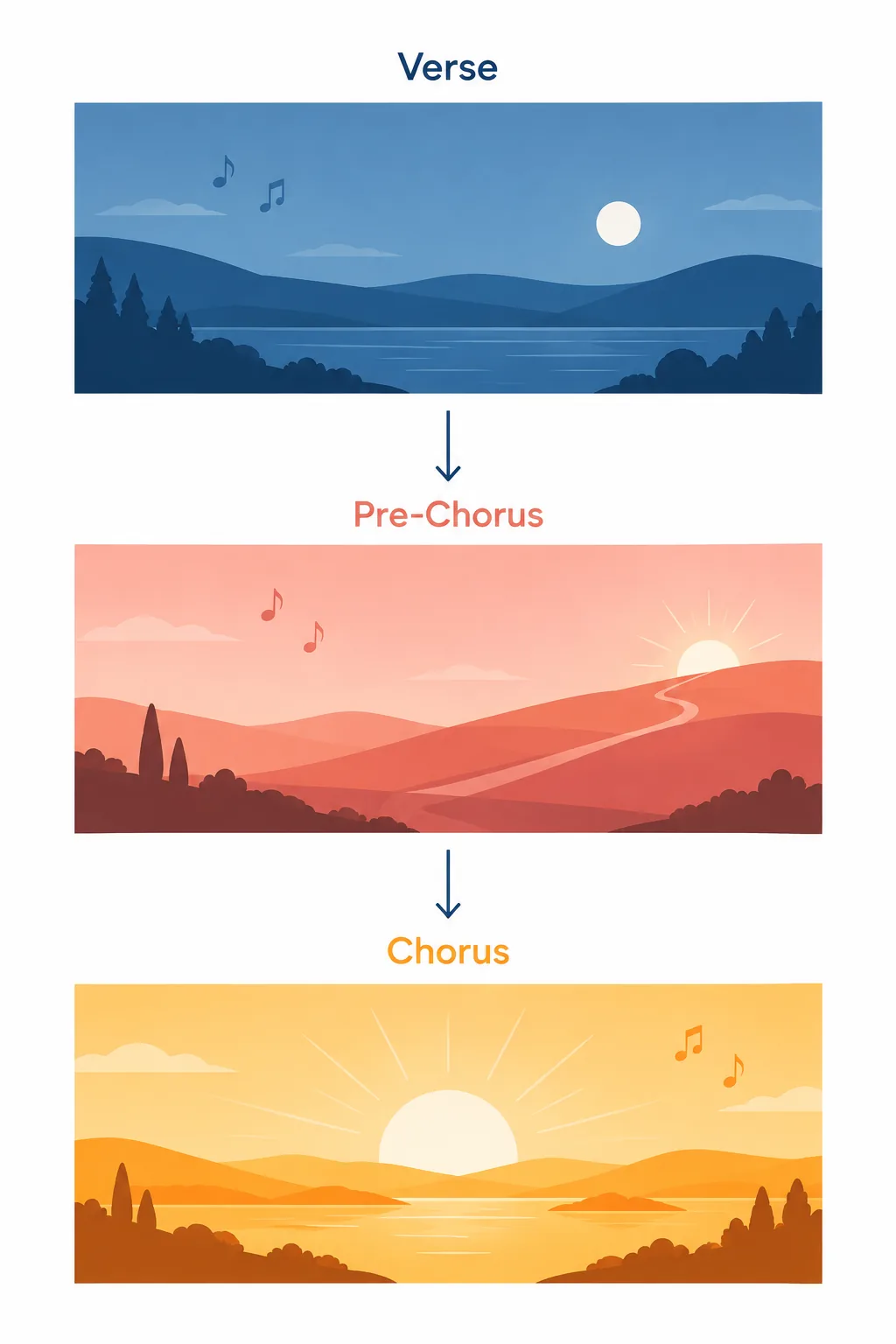
What is a pre-chorus in a song? It is an optional section between a verse and chorus that builds anticipation for the main hook. It may raise the melody, shorten the lyric lines, change the rhythm, add instruments, or hold back a final word. Unlike a chorus, it usually does not carry the song’s main repeated message. Unlike a bridge, it points forward to a known destination rather than creating a later detour.
- It connects a verse to the chorus and increases momentum.
- It often uses a different rhythm, melody, register, or arrangement.
- It can be two, four, or eight bars, but function matters more than the number.
- It should make the chorus feel more inevitable without stealing the hook.
- It is optional; a direct verse-to-chorus move can be stronger in many songs.
1. What a pre-chorus does
A pre-chorus is a short transition section that prepares the listener for the chorus. It usually appears after a verse and before the repeated hook, but its real identity comes from its job: it increases expectation. The lyric may become more direct, the melody may climb, or the arrangement may remove space so the chorus has somewhere to open up. Think of it as a runway rather than a second chorus: the verse gives scenes or a question, and the pre-chorus gathers them into a feeling that is about to break open.
- Ask what the listener should be waiting to hear after the verse.
- Give the section one clear direction instead of adding a new story branch.
- Leave enough space for the chorus to remain the emotional destination.
Review the Song Structure Guide — to compare the jobs of verse, pre-chorus, chorus, bridge, and outro.
2. Pre-chorus vs. verse, chorus, and bridge
The easiest way to identify a pre-chorus is to compare its function with nearby sections. A verse normally adds information, images, or a new scene. A chorus repeats the central emotional promise. A bridge creates contrast after the main pattern is familiar. The pre-chorus sits between those roles: it changes the pressure just before the chorus so the repeated message lands with more force. The boundaries can blur, so focus on function rather than the label: if a section appears before the chorus and makes it feel more inevitable, it is doing pre-chorus work.
- Verse asks what happened; pre-chorus asks what is about to happen.
- Chorus repeats the main promise; pre-chorus increases the pressure around it.
- Bridge changes the frame later; pre-chorus points toward the next familiar section.
| Section | Main job | Useful question |
|---|---|---|
| Verse | Adds scenes, details, or story movement | What is happening? |
| Pre-chorus | Builds expectation before the hook | What is about to arrive? |
| Chorus | Repeats the emotional promise | What should the listener remember? |
| Bridge | Creates later contrast | What has changed or not been said? |
3. How to write pre-chorus lyrics
Start with the emotional sentence that connects the verse to the chorus. If the verse shows someone hesitating at a door and the chorus says they are finally leaving, the pre-chorus might hold the last second of doubt: the hand is on the handle, the old excuse is losing power, and the decision is close. Keep the language narrower than the verse, use shorter lines or a repeated phrase, and remove words that delay the turn without adding emotion, rhythm, or tension.
- Write the transition as one plain sentence before shaping the lyric.
- Use repetition with a small change when the decision is becoming clearer.
- End on a word, image, or question that makes the chorus entrance easy.
Try the Chorus Generator — for hook directions you can connect to your own verse and pre-chorus.
4. Build the musical lift without forcing it
A pre-chorus can rise in several ways. Move the melody upward, hold a longer vowel, make the rhythm more active, shorten the rests, or place the vocal in a different register. You can also create lift by taking something away: a muted drum pattern, a thinner texture, or a brief pause can make the first chorus beat feel larger. Choose one or two changes that match the song’s mood, and judge them by whether they make the chorus clearer rather than merely louder.
- Let the most important pre-chorus word land on a strong beat or sustained note.
- Compare its melodic range with the verse and chorus before pushing higher.
- Use a pause or reduced texture when the song needs suspense rather than volume.
5. How long should a pre-chorus be—and do you need one?
There is no universal pre-chorus length. Two bars can work in a fast pop song, while four or eight bars may give a slower song enough time to turn. Count phrases and breaths instead of copying a number. Keep the section when it creates contrast, clarifies the emotional turn, or gives the chorus a satisfying launch; cut it when it only delays a hook that was already ready to arrive. A direct verse-to-chorus move can be stronger when the verse already has a clear pickup.
- Test two, four, and eight-bar versions against the same chorus entrance.
- Keep the shortest version that creates a noticeable change in expectation.
- Remove the pre-chorus if the song becomes more direct and memorable without it.
6. Test the transition and revise the weak point
Listen to the verse, pre-chorus, and chorus as one continuous movement. Check whether the pre-chorus answers or sharpens the verse’s question, leaves enough breath, and makes the chorus feel like a payoff rather than a continuation. Make one change at a time: cut a line, move the hook word to the final beat, change one chord, open the drums, or lower the melody so the chorus can rise. If you remember the chorus but not the pre-chorus, that can be a success—the transition did its job without becoming the destination.
- Ask a listener what they expected after the pre-chorus, not only whether they liked it.
- Protect the chorus hook if the transition starts attracting more attention than the refrain.
- Use the Song Structure Generator to test whether the section still earns its place in the full form.
Test a song structure — after you know what the pre-chorus is supposed to change.
Worked example: turn a verse idea into a pre-chorus
Imagine a song about leaving a familiar city. The verse shows packed boxes and one last walk past the station. The chorus promises, “I can go and still carry home.” The pre-chorus should not repeat the boxes; it should make the decision feel close.
- Verse question
- Can the speaker really leave the routine behind?
- Pre-chorus thought
- The train is waiting, the old excuse has already been said, and the next step cannot be postponed.
- Lyric shape
- Use three shorter lines that repeat a rising phrase, then leave a breath before the chorus.
- Musical change
- Hold the final vowel longer and let the bass climb while the drums stay restrained.
- Chorus payoff
- The chorus now sounds like a decision, not a general statement about travel.
The pre-chorus works because it narrows the distance between the scene and the hook. It adds pressure without introducing a second theme, so the chorus can deliver the emotional answer.
Common pre-chorus mistakes
Writing a second chorus
If the section states the full emotional promise and has the catchiest phrase, the chorus may feel unnecessary. Keep the pre-chorus pointed toward the hook.
Adding words only to fill bars
A longer section is not automatically more dramatic. Cut filler and let a pause or instrumental change create tension.
Changing everything at once
A new key, rhythm, texture, and vocal range can make the section feel disconnected. Start with one clear contrast.
Forgetting the verse setup
The pre-chorus should grow from the verse’s image or question. If it introduces a random idea, rewrite the transition sentence.
Keeping it because the template says so
A pre-chorus is optional. Remove it when a direct verse-to-chorus move creates a cleaner and more memorable song.
Frequently asked questions
What is a pre-chorus in a song?
A pre-chorus is an optional section between the verse and chorus. It builds anticipation through lyrics, melody, rhythm, harmony, or arrangement so the main chorus feels like a stronger arrival.
What is the difference between a pre-chorus and a chorus?
The chorus carries the song’s repeated emotional message and hook. The pre-chorus prepares that message by increasing tension or changing the musical shape immediately before the chorus.
Is a pre-chorus the same as a bridge?
No. A pre-chorus usually appears before a chorus and points toward a familiar return. A bridge usually arrives later, creates contrast, and changes the listener’s perspective before another section returns.
How many bars is a pre-chorus?
There is no fixed answer. Two, four, or eight bars are common possibilities, but the best length is the shortest phrase that creates a meaningful change in expectation and leaves room for the chorus.
Does every song need a pre-chorus?
No. Use one when the verse needs a step of tension or the chorus benefits from a controlled lift. Skip it when the verse already leads naturally into a memorable chorus.
Ready to test your next transition?
Start with the verse question, write the smallest useful lift, and let the chorus keep the final word.